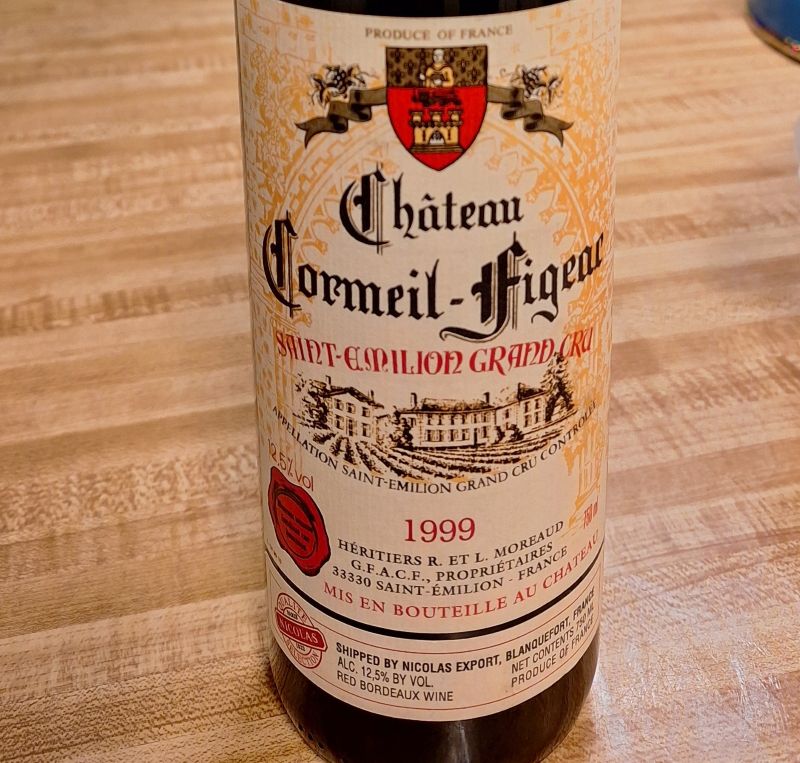
Inspired by a 1999 Bordeaux wine, Carmen and I talked about wines from the region and how to decipher French wine labels. We also recapped some of our picks from the January 10th show where we talked about Northern Italian Wines Celebrating the Winter Olympics Milano Cortina 2026.
Our new friend and member of the Tony Mart family, Laura Keiter brought a 1999 Chateau Cormeil-Figeac Saint-Emilion Grand Cru to dinner last week and we were very excited to taste a 27-year-old Bordeaux.
French wine labels are challenging because they don’t always tell you what’s inside the bottle. The first clue is easy, as it says “Product of France”. Below that is “Chateau Cormeil-Figeac” A Chateau is a wine estate so this is the winery where the wine is produced.
Under the winery name is “Saint-Emilion Grand Cru”. There are two pieces of information here. First is the appellation “Saint Emilion” which is in the Bordeaux region. Bordeaux is in the western part of France surrounding the Gironde Estuary and the Dordogne River. It is a highly regulated region that allows wine produced from five grape varietals – Cabernet Sauvignon, Merlot, Cabernet Franc, Malbec, Petit Verdot – to be blended into their red wines. (White wines are also produced but we’ll save that for another day.) The right banks of the estuary and river are generally better suited for Merlot and so wines from those appellations are Merlot dominant whereas the terroir of left bank is better for growing Cabernet Sauvignon grapes and produce wines that are Cabernet Sauvignon dominant. Cabernet Franc, Malbec, and Petit Verdot are the blending grapes and are used in smaller amounts. We find the prestigious Saint Emilion appellation on the right bank, telling us that our bottle is Merlot dominant.
The second piece of information is “Grand Cru” which is one of the top tier classifications. Bordeaux quality Classifications are varied and region-specific. The classifications are applicable to sub-regions such as Medoc, St. Emilion, and Graves. Look for Grand Cru Classe or Grand Cru for St. Emilion. For Medoc look for numbered tiers such as Premier Cru (1st), or Cru Bourgeois Exceptionnel or Superior. The Cormeil-Figeac estate is recognized for exceptional quality, due to superior terroir.
Under the appellation and classification is the vintage, 1999. The vintage is the year in which the grapes were grown and harvested. We’re drinking a wine that’s been aging for 27 years. Is this a good thing? Some wines are built for aging by incorporating high levels of tannins and acidity, as well as using specific methods of oak aging. Certain grape varieties such as Cabernet Sauvignon contribute to making wine age-worthy. While Cabernet Sauvignon based Bordeaux wines generally age better than Merlot based, Cormeil-Figeac in particular is promoted as having good aging potential for medium to long cellaring.
The verdict: The cork was difficult to open. Even when stored correctly, corks that age tend to crumble upon opening. I managed to strain out the bigger pieces. We realized later that we should have prepared with a decanter.
At first appearance the wine is slightly brick around the edges but generally robust in color. On the nose and palate are dried fruits but it starts off a bit tight. As the night went on, I refilled my glass and was so glad I did because the wine had completely evolved into something spectacular. Dried fruit, petrol, and licorice on the nose. Candied berries, cola, prune, and cola on the palate. A long, lingering finish with strong notes of vanilla. Spectacular balance, complexity, and smooth, silky tannins.
Since Mike and I don’t cellar wines more than a few years, tasting this well-aged Bordeaux wine was an edifying and exciting experience.
You may not be able to find a 1999 vintage to try at home but here are some Bordeaux suggestions available at Circle Liquor Store.
For the budget-minded:
Chateau Teyssier – Wine estate in Saint-Emilion, just like our bottle from Laura. Known for its Grand Cru wines. This is an entry level wine by a significant player in the Right Bank Bordeaux scene. Historic estate that has been revitalized and modernized. Tasting notes: Rich and full-bodied with dark fruit, spice, and earthy notes.
Legende Bordeaux Rouge – Produced by Domaines Barons de Rothschild (Lafite), the same family behind the iconic first-growth Chateau Lafite Rothschild. A Cabernet Sauvignon/Merlot blend leaning more toward the Cab. Medium to full-bodied with aromas and flavors of red and dark fruit such as raspberry, blackberry, and black currant with hints of sweet spices like vanilla and cinnamon.
Priced Mid-Range:
Chateau Alcee Cotes de Castillion – Castillion Cotes de Bordeaux is a satellite appellation in the Bordeaux region. Known for its elegant, fruity, and mineral driven style. Dark berries, licorice, spice, and floral notes. Food friendly.
Chateau de Pez Saint Estephe – The Saint Estephe appellation, the Chateau, one of the oldest in the Left Bank, is a historic estate owned by Louis Roderer. Cru Bourgeois Exceptionnel classification. Full-bodied with aromas and flavors of dark berries, licorice, forest floor, violets, and spice.
Premium and Built for Aging: Chateau Lagrange Saint Julien – The Saint Julien appellation, produced from a single vineyard with a superb location on the Left Bank. Grand Cru Classe classification. Floral, smoke, and earthy notes on the nose. Powerful on the palate with flavors of red berries and cassis. Graphite and tobacco in a long finish.
 Boozy Lifestyle©